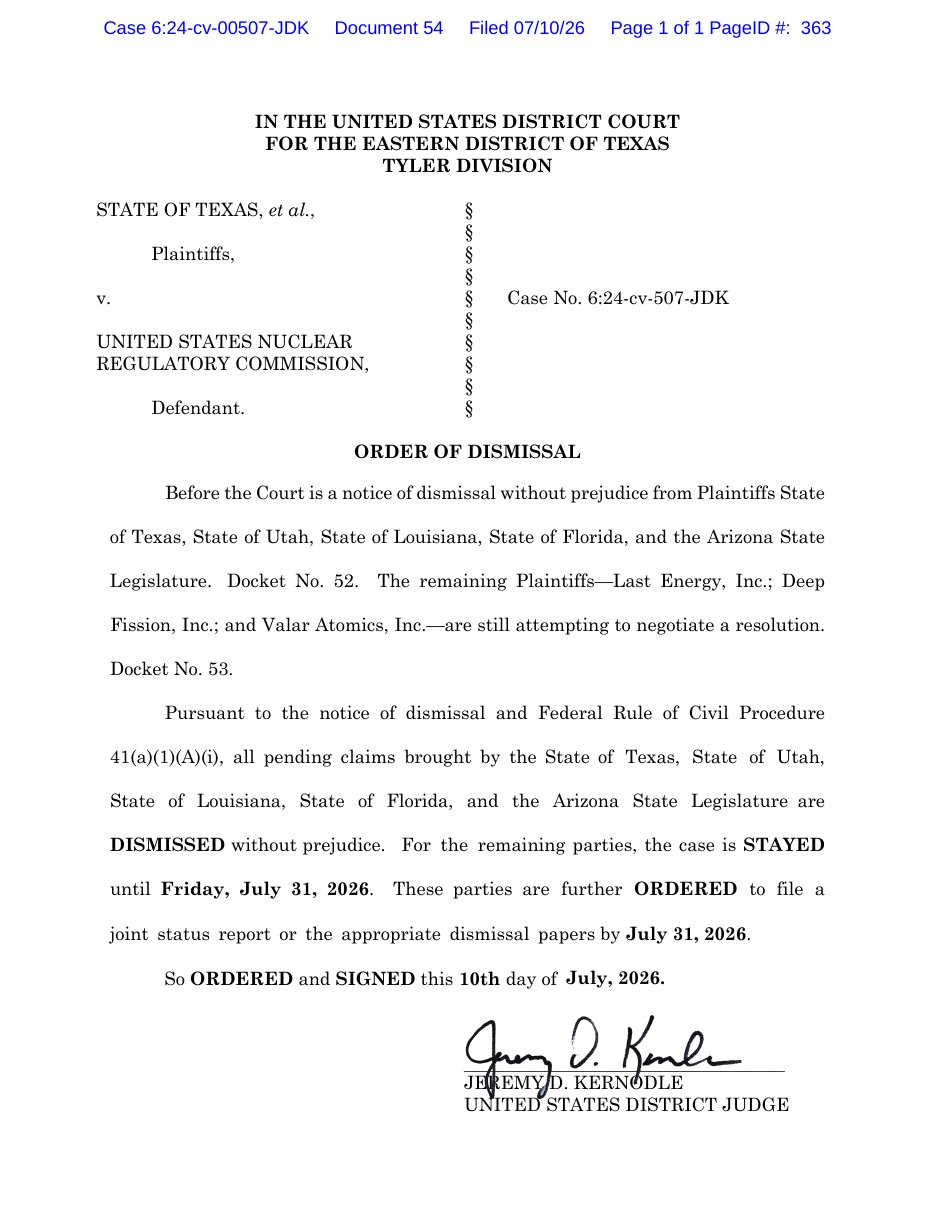
On June 24, 2026, Texas, Utah, Louisiana, Florida and the Arizona State Legislature filed to drop their own claims in their lawsuit against the Nuclear Regulatory Commission (NRC), without prejudice. The court dismissed them on July 10 [10]. Valar Atomics did not drop out, and neither did the two other reactor startups in the case, Last Energy and Deep Fission. On September 2, the three companies and the NRC told the court they “have continued to confer regarding potential terms of a settlement and whether a further extension of the abeyance is necessary.” [10] No filing gives a reason for the states’ exit, and nothing had been filed since, as of October 20, 2026.
How did a lawsuit meant to free small reactors from federal licensing end up as three startups negotiating with the regulator? Follow the dates.
Utah’s two positions
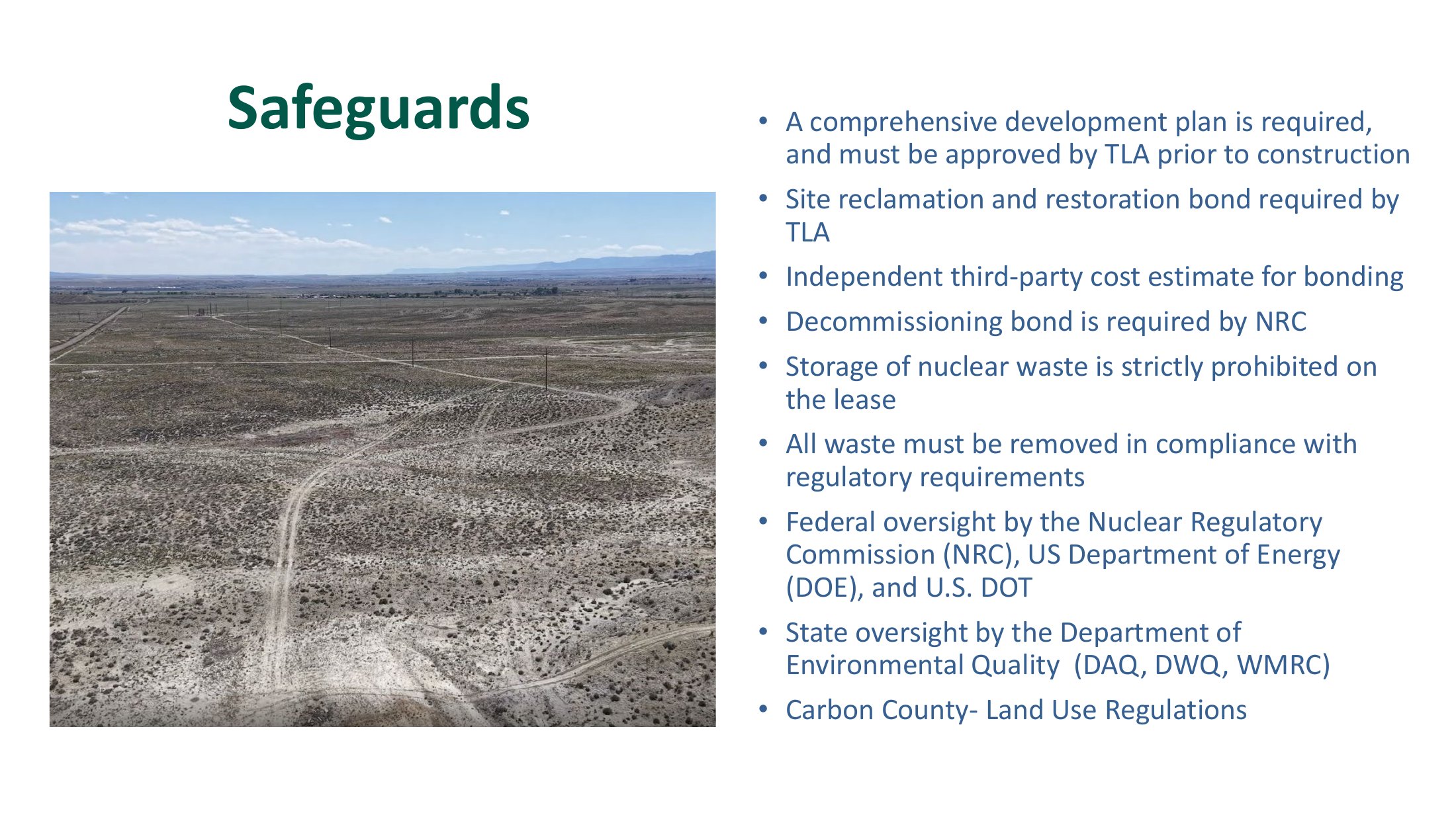
For a year and a half, the State of Utah was a plaintiff in a lawsuit arguing that the NRC’s licensing rule should not reach small reactors [1, 10]. On September 17, 2026, Utah’s Trust Lands board voted on Valar’s lease of state land north of Wellington. Its staff memo says the NRC handles “commercial safety licensing,” with requirements “that Valar Atomics will be required to adhere to.” [22] The board’s slides list “Federal oversight by the Nuclear Regulatory Commission (NRC)” under the heading “Safeguards.” [23] At the time of that vote, Utah had left the suit, but Valar was still in it, asking the court to declare its reactors exempt from NRC facility licensing [4, 10].
How it started
On December 30, 2024, the states of Texas and Utah, along with Last Energy, another nuclear startup, filed a complaint against the Nuclear Regulatory Commission (NRC) [1]. Their target was a 1956 rule that treats almost every nuclear reactor, whatever its size, as a “utilization facility” that needs an NRC license [1]. The complaint argued that the rule should not reach small reactors.
The NRC was served on January 17, 2025 [2]. On March 17, 2025, it moved to dismiss [3]. Its main argument rested on the Hobbs Act, a law Congress passed that gives the federal courts of appeals the exclusive power to review the validity of NRC rules governing its licensees [3, 5]. Put simply, the NRC said this trial court had no authority to hear the case at all. If the court disagreed, the NRC offered two more reasons to throw the case out, and it pointed the plaintiffs to the routes it said they had skipped.
- Too late. Federal law gives six years to sue the government over a regulation, counted from when the right to sue first arises (28 U.S.C. § 2401(a)). The rule being challenged dates to 1956. The NRC argued that Texas could have sued, at the latest, in 1957, when it began running a licensed reactor, so its claims were decades too late [5]. In a footnote, it said “the same is true” for Utah, whose research reactor has operated under an NRC license since 1975 [3]. The NRC did not make this argument against Last Energy.
- Wrong courthouse. A suit against a federal agency has to be filed where the agency is, where the events happened, or where a plaintiff lives. The NRC is in Maryland. The plaintiffs filed in Tyler, Texas, because Texas lives there. Utah, and the states and legislature that joined later (Louisiana, Florida and the Arizona Legislature), do not, and the NRC said no company plaintiff has its principal place of business there [5]. So if Texas’s claims were too late, the NRC argued, nobody left in the case could keep it in Tyler. In its words, “A plaintiff cannot be joined for the purpose of creating venue where it would not otherwise exist.” [5]
- Just ask. The NRC said the plaintiffs skipped the normal routes. Anyone can petition the NRC to change a rule (10 C.F.R. 2.802). The NRC can also exempt a particular facility from licensing if the exemption “will not endanger life or property or the common defense and security” (10 C.F.R. 50.12), and a refusal can be challenged in court [3, 5]. Instead, it said, the plaintiffs came straight to court “rather than working cooperatively with the NRC to address their objections to this longstanding rule by petitioning the agency to change it.” [5]
Why would states and reactor startups go straight to court rather than ask the regulator? The filings give the plaintiffs’ side in their complaint, and no judge has weighed it.
On April 7, 2025, the plaintiffs filed an amended complaint that added Louisiana, Florida, the Arizona State Legislature, Deep Fission and Valar Atomics [4]. Valar asked the court to declare its reactors exempt from NRC facility licensing, while still subject to state radiation rules, and only so long as their containment prevents a hazardous release [4]. The next day, the judge denied the NRC’s first motion to dismiss as moot, because the complaint it attacked had been replaced [6]. Three weeks later, on April 28, the NRC moved to dismiss again on the same grounds [5]. No judge has ruled on it. None of the court filings DIG has reviewed, through September 2, 2026, contain a ruling on any of the NRC’s arguments.
The pauses, and the orders
Between May 2025 and August 2026, the court paused the case twelve times; eleven of those pauses came at the joint request of both sides, and the twelfth with the court’s order dismissing the states’ claims [11]. The first request is notable. On April 30, 2025, every party asked for a 60-day pause “to consider alternatives to pursuing this case further, without Plaintiffs facing a pending deadline to respond to the Nuclear Regulatory Commission’s Motion to Dismiss.” [7] The judge granted it the next day [8]. On May 23, 2025, President Trump signed four executive orders that bore directly on the NRC and on what the plaintiffs were asking for [12, 13, 14, 15]. A week later, the parties told the court they were “assessing how [four recently issued] Executive Orders impact this case.” [9]
1. EO 14300, Ordering the Reform of the Nuclear Regulatory Commission
This order added a new duty to the NRC’s mission: the agency’s mission “shall include facilitating nuclear power while ensuring reactor safety,” and in licensing it must weigh the economic and national-security benefits of nuclear power alongside safety, health and the environment [12]. It told the NRC to reorganize in consultation with its DOGE team, including reductions in force, and to cut its safety advisory committee to the minimum the law requires [12]. It ordered a “wholesale revision” of NRC rules: proposed within 9 months, final within 18 [12]. The NRC must decide on a new reactor within 18 months at most, and on extending an existing reactor’s license within one year [12]. The order told the NRC to reconsider the radiation-safety models it called flawed, the “linear no-threshold” model and the “as low as reasonably achievable” standard [12]. It ordered a process for “high-volume licensing of microreactors and modular reactors,” possibly through general licenses, and an expedited path for reactor designs already tested by the Department of Energy or the military [12]. Its list ends with an order to “streamline the public hearings process.” [12]
2. EO 14301, Reforming Nuclear Reactor Testing at the Department of Energy
This order found that test reactors under the Department of Energy’s “sufficient control” that do not produce commercial power fall under DOE’s jurisdiction, not the NRC’s [13]. It ordered DOE to create a pilot program outside the national laboratories, with the goal of at least three reactors reaching criticality by July 4, 2026 [13]. On August 12, 2025, DOE selected eleven projects from ten companies, among them all three companies in the lawsuit: Valar Atomics, Last Energy and Deep Fission [20]. Valar’s Ward 250 test reactor reached criticality under that program in Emery County in June 2026 [21].
Also signed that day
EO 14299 ordered a reactor, regulated by the Army, at a domestic military base, and told the Department of Energy to put privately funded reactors powering AI data centers on DOE land, the first within 30 months, with at least 20 metric tons of HALEU fuel set aside for them [14]. EO 14302 took on fuel and waste: a plan to expand U.S. uranium conversion and enrichment, including highly enriched uranium (HEU, the weapons-grade material that also fuels Navy reactors); a report on spent fuel, recycling and reprocessing within 240 days; Defense Production Act agreements letting competing nuclear companies plan and buy together, backed by DOE guarantees; and goals of 5 gigawatts of uprates and 10 new large reactors under construction by 2030 [15].
The case and the orders, side by side
The table below sets the lawsuit against the executive orders’ deadlines and the rules the NRC proposed under them. Study it.
| Date | Lawsuit: State of Texas et al. v. NRC (E.D. Tex.) | Executive orders and NRC rules |
|---|---|---|
| 30 Dec 2024 | Texas, Utah and Last Energy sue the NRC (Dkt 1). | |
| 7 Apr 2025 | Valar Atomics joins as a plaintiff in the amended complaint, with Louisiana, Florida, the Arizona Legislature and Deep Fission (Dkt 10). | |
| 28 Apr 2025 | The NRC moves to dismiss the amended complaint (Dkt 16). No ruling on it appears in the filings through 2 Sept 2026. | |
| 1 May 2025 | First stay, on all parties' joint request “to consider alternatives” (Dkt 17, 18). | |
| 23 May 2025 | Executive Orders 14299 to 14302 signed. EO 14300 gives the NRC 9 months to propose its rule revisions and 18 months to finalize them (90 FR 22587). | |
| 27 Jun 2025 | Joint motion cites the executive orders and “potential options for a mutually agreeable resolution” (Dkt 23). | |
| 12 Aug 2025 | DOE selects 11 Reactor Pilot Program projects, including Valar, Last Energy and Deep Fission (DOE). | |
| 26 Sep 2025 | Joint motion: a meeting is set “in light of anticipated rulemaking planned by” the NRC “pursuant to the Executive Orders” (Dkt 27). | |
| Oct–Nov 2025 | Talks paused by the federal funding lapse; funding returned 12 Nov 2025 (Dkts 32, 34, 36). | |
| 23 Feb 2026 | The executive order's deadline for the NRC's microreactor proposed rule, as the NRC's own notice states it (91 FR 23628). | |
| 3 Mar 2026 | NRC proposes streamlined rules for contested licensing hearings, citing EO 14300 (91 FR 10450). | |
| 6 and 12 Mar 2026 | The parties exchange “possible settlement terms” (Dkt 42). | |
| Apr 2026 | Reported: a plaintiffs' lawyer emailed colleagues that the NRC was willing to settle (The New Republic, 26 May 2026, citing Bloomberg Businessweek). No settlement has been filed. | |
| 1 May 2026 | NRC publishes the proposed microreactor rule (10 CFR Part 57). It carries the 1956 “utilization facility” definition into the new part (91 FR 23628). | |
| 15 Jun 2026 | Comment period on the microreactor rule closes. | |
| 17 Jun 2026 | All parties say they “require additional time to finalize an agreement” (Dkt 50). | |
| 18 Jun 2026 | DOE announces Valar's Ward 250 reached criticality in Emery County (DOE). | |
| 24 Jun 2026 | The five state plaintiffs file to dismiss their own claims, without prejudice (Dkt 52). | |
| 10 Jul 2026 | The court dismisses the states' claims without prejudice; Valar, Last Energy and Deep Fission remain (Dkt 54). | |
| 2 Sep 2026 | Joint status report: the remaining parties are still conferring on settlement terms (Dkt 57). | |
| 23 Nov 2026 | The executive order's deadline for the final microreactor rule. |
What the new rules could mean in Utah
Between March and September 2026, the NRC published a series of proposed rules under EO 14300. Several reach directly into what Valar has planned for Carbon and Emery counties:
- A shortcut for designs DOE already tested. The April rule would let a company carry a Department of Energy authorization of a demonstration reactor straight into its NRC license review [18]. Ward 250, at the San Rafael lab in Emery County, was authorized by DOE, not the NRC [21].
- Changes to how a license is contested. The March rule revises the rules for contested hearings in NRC licensing proceedings, the forum where residents and local governments can formally challenge a license [19].
- Fleets, and building before a permit. The NRC says Part 57 would allow approval of fleets of identical reactors, streamlined environmental reviews for projects with “demonstrated minimal impacts,” and “limited construction prior to receiving an NRC permit,” with licensing in as little as 6 to 12 months [17].
These are what the proposed rules would allow. No record shows Valar has applied under any of them.
| Published | Proposed rule (Federal Register doc. no.) | What the NRC's published summary says |
|---|---|---|
| 3 Mar 2026 | Streamlining Contested Adjudications in Licensing Proceedings (2026-04187) | Revises the rules for contested hearings in licensing proceedings, in response to the ADVANCE Act and EO 14300. |
| 2 Apr 2026 | NRC Reviews of Reactor Designs Previously Authorized by U.S. Department of Energy or Department of War (2026-06414) | Would let commercial applicants draw directly on a prior DOE or Department of War authorization of a demonstration reactor in the NRC's licensing review. |
| 1 May 2026 | Licensing Requirements for Microreactors and Other Reactors With Comparable Risk Profiles, new 10 CFR Part 57 (2026-08550) | A new, faster licensing route for microreactors. Carries the 1956 “utilization facility” definition into the new part. Issued under EO 14300; final rule due by 23 Nov 2026. |
| 26 Jun 2026 | Modernizing Security Requirements (2026-12989) | Revises security and fitness-for-duty requirements to “reduce regulatory burden, where appropriate,” consistent with EO 14300. |
| 7 Jul 2026 | Implementation of the National Environmental Policy Act (2026-13687) | Streamlines how the NRC carries out environmental reviews; cites EO 14300 among other directives. |
| 15 Jul 2026 | Reforming and Modernizing the NRC's Radiation Protection Framework (2026-14208) | Revises the radiation protection standards under section 5(b) of EO 14300; the last major revision was in 1991. |
| 16 Jul 2026 | Modernizing Reactor Licensing, Safety Oversight, and Siting Practices (2026-14341) | Part of the “wholesale revision” of NRC rules under sections 5(f), 5(h) and 5(i) of EO 14300. |
| 11 Aug 2026 | NRC Modernization: Rulemaking Procedure, Federal Advisory Committee Act Alignment, Access, and Security (2026-16373) | Streamlines procedural rules, in response to EO 14300. |
| 24 Sep 2026 | Regulatory Enhancements for Reactor Licensing, Decommissioning, and Operational Oversight (2026-19568) | “One effort” under section 5 of EO 14300. Comments close 9 Nov 2026. |
Where the case stands
At a Valar town hall in Price on September 29, 2026, KOAL News reported Taylor saying:
“I can say this now because it was leaked, but the NRC actually has been told to settle with us. So we were right about that lawsuit.”
— Isaiah Taylor, Valar Atomics CEO, as reported by KOAL News [24]
Sources
Court record, No. 6:24-cv-00507-JDK (E.D. Tex.)
- Complaint, State of Texas et al. v. U.S. Nuclear Regulatory Commission, No. 6:24-cv-00507 (E.D. Tex.), Dkt 1, filed 30 Dec 2024. PDF. ↩ a b c
- Summons returned executed, Dkt 8, filed 22 Jan 2025 (NRC served 17 Jan 2025). PDF. ↩
- NRC motion to dismiss, Dkt 9, filed 17 Mar 2025; Utah footnote at p. 12. PDF. ↩ a b c d
- First Amended Complaint, Dkt 10, filed 7 Apr 2025; Valar's request (Prayer F) at pp. 93–94. PDF. ↩ a b c
- NRC renewed motion to dismiss, Dkt 16, filed 28 Apr 2025; Hobbs Act (28 U.S.C. 2342(4)); timeliness; venue at pp. 17–19. PDF. ↩ a b c d e f g
- Order denying the first motion to dismiss as moot, Dkt 11, 8 Apr 2025. PDF. ↩
- Joint motion to hold in abeyance, Dkt 17, filed 30 Apr 2025. PDF. ↩
- Order granting the stay to 30 June 2025, Dkt 18, 1 May 2025. PDF. ↩
- Joint status report of 30 May 2025 (Dkt 21), as quoted in the joint motion of 27 June 2025, Dkt 23. PDF. ↩
- Notice of voluntary dismissal, Dkt 52 (24 June 2026); order of dismissal, Dkt 54 (10 July 2026); joint status report, Dkt 57 (2 Sept 2026). Dkt 52 · Dkt 54 · Dkt 57. ↩ a b c d
- Stay orders: twelve between 1 May 2025 and 3 Aug 2026 (Dkts 18, 24, 28, 34, 37, 41, 43, 45, 49, 51, 54, 56). Eleven followed joint motions; the stay in Dkt 54 came with the order dismissing the states' claims, after a joint status report (Dkt 53) that asked for none. The stays were not continuous: none was in effect from 25 June to 10 July 2026. ↩
Executive orders
- Executive Order 14300, “Ordering the Reform of the Nuclear Regulatory Commission,” 90 FR 22587 (29 May 2025). Federal Register. ↩ a b c d e f g h i
- Executive Order 14301, “Reforming Nuclear Reactor Testing at the Department of Energy,” 90 FR 22591. Federal Register. ↩ a b c
- Executive Order 14299, “Deploying Advanced Nuclear Reactor Technologies for National Security,” 90 FR 22581. Federal Register. ↩ a b
- Executive Order 14302, “Reinvigorating the Nuclear Industrial Base,” 90 FR 22595. Federal Register. ↩ a b
Nuclear Regulatory Commission
- NRC, “Licensing Requirements for Microreactors and Other Reactors With Comparable Risk Profiles,” proposed rule, 91 FR 23628 (1 May 2026); comments closed 15 June 2026. Federal Register. ↩ a b c
- NRC news release 26-047, “NRC Proposes a New Licensing Framework to Accelerate Safe, High-Volume Deployment of Microreactors,” 24 Apr 2026. PDF. ↩
- NRC, “NRC Reviews of Reactor Designs Previously Authorized by U.S. Department of Energy or Department of War,” proposed rule, 2 Apr 2026. Federal Register. ↩
- NRC, “Streamlining Contested Adjudications in Licensing Proceedings,” proposed rule, 91 FR 10450 (3 Mar 2026). Federal Register. ↩
Department of Energy
- U.S. Department of Energy, Reactor Pilot Program (selections of 12 Aug 2025). energy.gov. ↩
- U.S. Department of Energy, “Department of Energy Celebrates Second Advanced Reactor Achieving Criticality,” 18 June 2026. energy.gov. ↩ a b
Utah records
- Utah Trust Lands Administration, board packet for 17 Sept 2026, Item 10A (SULA 2095), staff memo. PDF. ↩
- Utah Trust Lands Administration, 17 Sept 2026 board meeting presentation, Item 10A slides. PDF. ↩
News reports
- KOAL News (Castle Country Radio), “Valar Atomics hosts community open house amid community concerns over proposed developments on state and federal lands,” 1 Oct 2026. castlecountryradio.com. ↩